Showing posts with label Education. Show all posts

Tuesday, April 20, 2010

Chapter 85.2: A Song in My Heart and Head (in Praise of Teachers)

I try not to write too much here about my kids, but lately their music has meandered through my brain a lot. Silly songs, educational songs, songs that should never be played to anyone over the age of three...

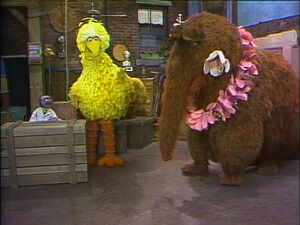
But as my girls graduated from the Baby Einstein videos to Sesame Street and Barney, I noticed something shocking: I knew some of these songs! Sure, there were standards like The People in Your Neighborhood and Rubber Ducky. But there was also one about lady bugs that I'd completely forgotten about.

I asked a co-worker what shows she remembered from her childhood. She was born to one of those families that didn't believe in television for many years, so she hadn't seen too much. But as she thought about it, she remembered seeing Barney. To this day, she said, she hums a song about cleaning up as she washes the dishes.

I've always had a thing for songs and song lyrics. I've entertained/pissed off people by singing the lyrics to a shortlived show from the late '70s called Hello Larry, which starred McLean Stevenson, after he left MASH. Long after I composed songs in my head as I walked to school as a kindergartner, I would find music offered me the first entree to a world of creativity.

It pains me to see the arts decimated in public education. I hate to hear about teachers losing their jobs or ridiculed by people who've never tried to teach that they get paid too much. Teaching children is perhaps the most important job in the world. Those that do it should be continually trained to do it better, and classrooms should be kept at relatively small sizes so that children receive the attention they need and deserve — which means that more teachers are necessary.

I know people will disagree with me. I've heard the arguments. Sometimes, those people make excellent points. But if it weren't for my parents and my teachers, I'd not have been able to succeed in the ways that I have.

Tuesday, May 15, 2007

Chapter 60.7: The 300; New Liberal Arts

Ok, this will be a disjointed post because I seem to be citing a recent movie (that I haven't seen) and combining it with a phrase that in that context makes no sense. So let me explain: this is my 300th post since starting this blog in 2004. More than some people, a lot few than many others. Self-congratulation is now over.

As for "the new liberal arts," that comes from an interesting post I saw at MIT Online, a publication at the Massachusetts Institute of Technology. The writer, who is from the university's class of 2007, discusses social entrepreneurism and the importance of the priveleged to give something back to sociey -- not simply make buckets of money. And he recounts an alumnus who told him "Engineering is the liberal arts of the 21st century."

What an interesting comment; it might even be true. I'm becoming more and more convinced that the state of education -- particularly math and science -- is at a dangerous low in this country. I've spoken with people from Microsoft and the former governor of a major manufacturing state as well as others who have similar concerns, and they believe that American students -- and their parents -- have no idea how poor their math and science skills are.

The liberal arts comment points to how broadly necessary those skills are and will become. Technology is at the heart of nearly everything we use today -- this computer I'm typing on, the cash register at the coffee shop where you bought your cup this morning, the blinking voice mail like reminding your co-worker that she's ignoring a client -- and our future is spending it on their hand-held game or their cell phone, oblivious to irony.

We are far from a tipping point, unless it's already tipped to the negative. Getting through to the kids will not be easy. And it's entirely possible they don't care and will blame us for letting their world fall apart. It's not enough that we've taught them to read; we need to help them learn how to think. That requires math and science as certainly as it requires art and literature.

Sunday, March 11, 2007

Chapter 58.314159: Good Math

Recently, the Seattle Post-Intelligencer posted a commentary calling for a commitment to emphasizing math in the schools. This call is certainly necessary, and long overdue. However, my pessimism may be getting the better of me. I'm not sure we can expect much. As the commentary states, we need better professional development of teachers, with a goal of training them to be more confident in their role. This takes time. No time like the present to start, but I think what we need to do is get math into more subjects; find where math fits into the history class, perhaps. Or make the examples in math class more accessible to kids: you have 500 songs on your iPod, what percentage of the memory is still available for more songs?

I'm not convinced the math block for many students is due to the subject matter. I think a big part of the problem is that math isn't cool. Maybe each student can have a team in a free fantasy league; each kid must keep their team under a salary cap. Work the numbers.

Easy for me to say -- I'm not teaching. Students who are bored are potentially disruptive, and one of the major challenges for education is classroom management. It takes more than teachers who are confident in their abilities to teach math, it takes teachers who are enthusiastic about teaching -- period. That involves a strong educational environment, a supportive administration, etc.

I'm all for emphasizing math, and I agree with Seattle -- home of the Bill & Melinda Gates Foundation -- being at the vanguard of a movement. But this will be a long slog, and the kids will need to see the light at the end of the tunnel. Kids don't implicitly care that the United States' position as an economic leader is imperiled without better math, science, and engineering education. They want to know what it means to them. Once that's been solved, you'll find more eager children.

Thursday, January 04, 2007

Chapter 54.5: Quality Counts

A new report has me more concerned about the state of education in this country than I already was. I’ve always appreciated that I grew up in an educated, inquisitive family in an area that was also well-educated and populated with folks who had a similar educational foundation. In short, I grew up with a lot of smart people.

While I understand intellectually that not everyone is as fortunate as I am in this regard, the findings of Quality Counts 2007 are staggering. It’s bad enough that the state-by-state analysis shows that the luck of the draw can hamstring a child’s development (God forbid you grow up in the beautiful state of New Mexico, it seems to say), but what’s worse is that even some states that “excel” relative to the others don’t always post impressive numbers. The top state in middle-school math, for example, is Massachusetts, where less than half of students meet NAEP (National Assessment of Educational Progress) standards. In Washington, D.C., the figures are abysmal – less than 7 percent!

I fear the level of mathematics knowledge has dwindled to near innumeracy. Ask most kids the difference between the mean and the median and you might consider yourself lucky if they knew one of them meant "the average." The strong students are better educated; for the average ones, it seems to be a matter of where you live and whether you had a strong enough grammar school experience to create an academic foundation for the future. And with the state of public education in many areas of the country being so horrible, we're in danger of developing an enormous number of youth in this generation who don't know how to think through problems far more challenging than what a statistical midpoint is called.

I’m not afraid for the smart students, the kids on the far end of the bell curve. I’m afraid for those in the middle. They are by definition the majority of students, and if we can’t educate them better, then the consequences for the future are harrowing.

Who or what is to blame? Is the curriculum too hard? I doubt it –- life is only getting more complicated as we strive to create more convenience for ourselves. Are teachers worse? Perhaps, but they’re also products of our education system -– it’s a chicken/egg argument that isn’t feeding anyone’s imagination to solve the problem. Public policy? State initiatives? Federal initiatives? Yes to all, but it’s still not enough. The thing that galls me most is there are a lot of smart people trying to solve this problem, and no one has an answer that doesn’t involve leaving a lot of children and young adults educationally destitute. I’m open to suggestions. Personally, I’m going to learn how to tutor someone and start there.